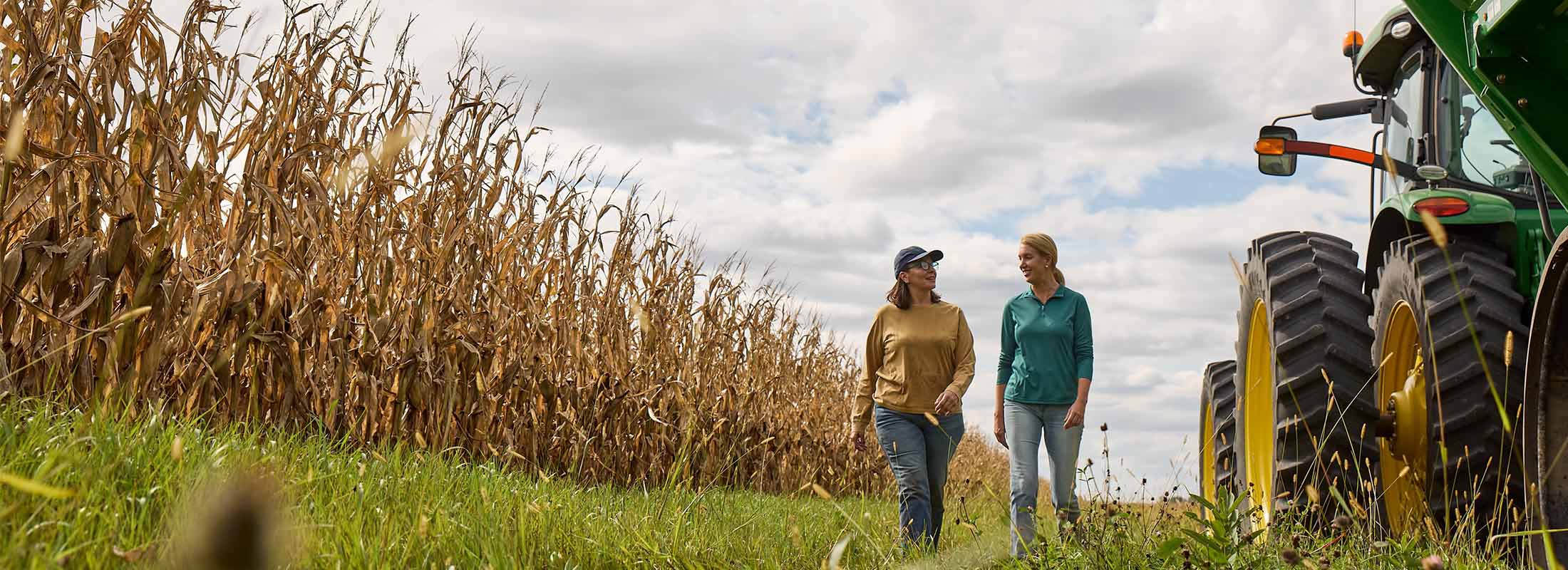

Note: This article is adapted from our previously published Sustainability Report. Content has been edited and reformatted for a blog audience, with minor updates for clarity and readability where appropriate. Customer-provided photos, used with permission.
Wendy Johnson has made her own path in agriculture. Some of the relationships she built along the way—from Practical Farmers of Iowa to PepsiCo® to her Farm Credit Association—have been vital to advancing her goals.
Key takeaways
Regenerative agriculture is a whole-system approach that improves soil health, biodiversity, and long-term farm resilience.
Farmers can boost profitability per acre by diversifying and reducing inputs rather than relying on intensive, single-crop systems.
The biggest hurdle is access to capital and clear ROI, making funding solutions like stewardship programs critical to adoption.
Growing consumer awareness around food quality and soil health is helping drive momentum for regenerative practices.
Johnson once worked in the fast-paced world of Los Angeles fashion. Today, she walks past grazing sheep and heritage pigs beneath rows of chestnut and apple trees at Joia Food & Fiber Farm. Across 130 acres in Charles City, Iowa, cattle rotate through thriving pastures, chickens and guineas forage in orchard alleys, and organic grains ripple in the wind.
“We have some of the richest soils in the Midwest,” she says. “We should be able to grow other things in other ways and help reduce the need for inputs. We’re really looking at our farm as a whole-system approach to diversification and growing more food, fiber, and energy for Americans and abroad.”
But a decade ago, this Northeast Iowa operation looked far different. When Johnson and her husband, Johnny Rafkin, left Los Angeles in 2010 to return to Johnson’s family land, the farm was strategically specialized. Like most Iowa farms, the operation focused on conventional corn and soybean production. Johnson wanted to return to her roots and secure the future of her family’s land—while also blazing her own trail.
Johnson co-manages her family’s larger, traditional operation, Center View Farms Co., with her father. She and her husband started Joia Food & Fiber Farm as an offshoot of that business. They use their farm to test and implement practices that prioritize water and soil health, biodiversity, and the long-term vitality of farmland and farmers.
In the first few years, Johnson farmed organic row crops. Later, she rotated the land to pasture to increase grazing capacity and address hydrology concerns. They added livestock, small grains, and agrofestry. The farm now markets flour milled from perennial grains, meats, eggs, and wool products directly to consumers through an online store and buying clubs.
“I want to see more farmers growing our food,” Johnson says. “To do that, we need to create space for them. The funnel used to be wide, and now it’s narrowing. I’m proud to be a farmer in America, and I want to see more opportunity for others to grow food and fiber.”
Scalable regenerative practices
Johnson has a unique vantage in agriculture. She can fine-tune production practices on her small farm and then see how they can scale on her family’s larger traditional farm.
"What we’ve learned in the last 10 years during our transition is how we can implement some of these strategies—maybe not all—across our family farm. It’s a slow process, but there is progress.
"
For example, Johnson’s father has long practiced no-till soybeans. During Johnson’s tenure, the operation has expanded to 100% no-till across all crops and incorporated cover crops and livestock grazing cover crops. The farm has also integrated small grains into the rotation.
“We are interested in how we can increase profitability per acre rather than relying on intensive tillage and one or two crops,” Johnson says. “I want to do low-stress farming. Farming is stressful enough because we can’t control markets or weather. No-till and cover crops are practical steps producers can take to reduce labor and improve soil health.”
Farm storytelling on the screen
In 2025, Wendy Johnson was one of three farmers featured in the “Food for Tomorrow” series, a collaboration between the National Geographic Society and PepsiCo to shine a spotlight on the global food system.
Johnson, along with farmers in Brazil and Thailand, shared their personal journey in regenerative agriculture.
“After meeting with the team and understanding their angle, I was very excited to be a part of it,” she says. “It created this cohesive space to connect and bring awareness to practices in agriculture that can be our future of growing food.”
Capital challenges
Shortly after returning to Iowa, Johnson became involved with Practical Farmers of Iowa. The organization’s core mission is to equip producers to build resilient farms and communities.
“They had a strong beginning farmer program focused on farmer-led learning,” she says. “I was able to learn directly from farmers implementing practices I was interested in.”
A few years ago, Practical Farmers of Iowa began working with PepsiCo, after the multinational organization announced it would invest in regenerative farming practices in the United States. Johnson is among the producers who advanced their stewardship activities with financial support from PepsiCo.
But access to the right capital is always a challenge. Every stewardship program has its own set of requirements, every improvement project, its unique objectives and risks. The more capital mechanisms a producer can pull, the faster they can advance their stewardship activities.
“Since I’m predominantly a perennial farmer, it’s more challenging to find funding that supports perennial agriculture because it’s still new,” she says. “I’ve had to think outside the box, but there has been movement with private foundations and organizations that are focused on how perennial agriculture can help reduce costly inputs.”
Johnson is encouraged by Farm Credit’s pilot Stewardship Fund; it shows an understanding of the barriers to stewardship activities.
More than 40% of producers say they don’t have capital for stewardship because it is committed elsewhere; 63% cite unclear or low returns on investment as a barrier. The Stewardship Fund is meant to increase access to capital and reduce the financial risk of adopting, continuing, or expanding practices such as cover crops and rotational grazing. The pilot will help determine if the fund delivers.
"Farm Credit’s fund could be outstanding because it doesn’t really exist anywhere else, and it can make these investments easier for farmers.
"
Future of food
Amid the many day-to-day challenges of farming, Johnson remains optimistic about agriculture’s future.
“We’re at a prime time because Americans are really concerned about their food quality and how their own health relates to soil health,” she says. “I would have never thought a pandemic like COVID would be the major turning point to get people to really see that connection. Now there’s more awareness and knowledge about this connection between soil and water and food and ultimately, our health.”