
Terrain® is our service for timely insights on topics and trends impacting agriculture, delivered by a team of specialized economic and agriculture analysts. Additional Terrain articles can be found at TerrainAg.com.
Authors: Don Close
Article originally published in the June Issue of the National Cattlemen Magazine
Report snapshot
Situation
June is no longer the heaviest month of the year for fed cattle marketings due to a jump in days on feed. This, along with other factors, is disrupting the seasonal break late in the June contract for live cattle futures.
Impact
The extension of the spring rally through the life of the June contract has major ramifications for hedgers. It is forcing them to apply different strategies, using a softer hedge position than simply holding short futures positions for the summer.
Summertime is no longer slump time for fed cattle prices, and I see this new seasonal pattern sticking around. Cattle feeders need to rethink their hedging strategy for the duration of June contracts.
Historically, one of the most reliable market patterns in live cattle futures was that as soon as the April contract expired, the June contract would make a feeble effort to go to where April expired. Then the June contract would roll over to trade lower to sharply lower into expiration. Driven by the traditional seasonal increase in fed cattle offerings, this pattern was the seasonal rollover from the spring high to the decline to the summer/fall market low.
The break or collapse late in the June contract is no longer the case, for several reasons.
Reason no. 1: Fewer market-ready cattle
For one, June is no longer the heaviest month of the year for fed cattle marketings.
As the number of days on feed for conventional beef yearlings has jumped from 160-180 days to 200-220 days, the number of cattle available in June has become more limited.
The reduced availability of market-ready cattle, combined with the grilling season’s increased demand, is forcing packers to chase cattle much more aggressively later into the summer. That has supported both fed cattle prices and futures.
Reason no. 2: Beef-dairy crosses
Another factor is the increasing number of beef-dairy cross calves as a percentage of cattle on feed.
Analysts, including those working for packers, have less clarity into projected marketing dates for the cattle on feed. They don’t know reliably what percentage of cattle on feed are beef-on-dairy crosses, and the feeding window for beef-on-dairy crosses has a wider range (365-400 days). Simply put, packers don’t have as clear a picture of how many cattle are available from month to month, which may be contributing to the higher bids lasting longer.
Additionally, constant supply of beef-on-dairy crosses in the on-feed mix prolongs days on feed.
Reason no. 3: Consumer demand changed fundamentally
The third factor is less seasonal and more persistent consumer demand for beef.
COVID-19 was a catalyst for the shift to seasonal strength late in the June contract. When restaurants were forced to close during the pandemic, packers had to transition Prime and the upper one-third of Choice beef to retail in short order. Consumers were quick to realize that they could have a fine dining experience at home for about half the cost. Their demand for beef has fundamentally changed.
Fortunately, the industry has been able to provide consumers with what they’re looking for: high-quality beef. Carcasses grading Prime went from 2-4% to consistently on top of 10%. Consumers keep buying, and the industry has never looked back.
Ramifications for hedgers
While a key driver to the longer feeding cycles is the lower availability and higher price tag of replacement cattle to fill pens, there are other factors as well that indicate the change in seasonal patterns may be lasting. So, even when cattle supplies recover and/or feed grain prices spike, I am not convinced that days on feed will contract enough to renew price weakness during the June spot period.
The extension of the spring rally through the life of the June contract has major ramifications for hedgers.
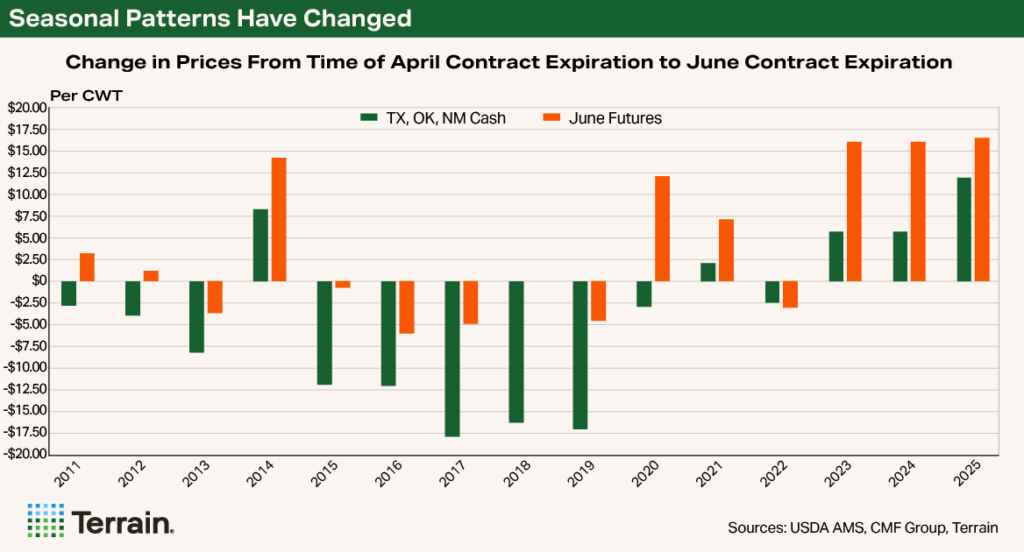
Historically, cattle feeders would absolutely be hedged following the expiration of the April contract. Now, with seasonal strength extending to the expiration of the June contract, it is forcing hedgers to apply different strategies using a softer hedge position than simply holding short futures positions for the summer.
Terrain® content is an exclusive offering of AgCountry Farm Credit Services, Farm Credit Services of America, Frontier Farm Credit, and American AgCredit.
While the information contained in this site is accurate to the best of our knowledge, it is presented “as is,” with no guarantee of completeness, accuracy, or timeliness, and without warranty of any kind, express or implied. None of the contents on this site should be considered to constitute investment, legal, accounting, tax, or other advice of any kind. In no event will Terrain or its affiliated Associations and their respective agents and employees be liable to you or anyone else for any decision made or action taken in reliance on the information in this site.